
Blogs
PoSH Compliance Audit 2026: Is Your Workplace Inspection-Ready?
- August 17, 2026
For several years, organisations have approached PoSH compliance primarily as an internal HR responsibility. A policy was created, an Internal Committee was constituted and employee training was conducted periodically.
That approach is now being tested against a more important question: Can the organisation demonstrate that its PoSH framework is legally compliant and operationally effective?
Recent developments point towards greater verification of workplace compliance. The Supreme Court has directed states and Union Territories to conduct surveys covering public and private organisations to determine whether Internal Committees have been constituted as required under the PoSH Act.
The Ministry of Women and Child Development reported that, as of 27 March 2026, more than 161,000 workplaces with over ten employees had been onboarded on the SHe-Box portal. However, Internal Committee details had been updated for approximately 68,460 workplaces. The government is also working with state authorities, labour departments and industry bodies to increase workplace onboarding and compliance monitoring.
For employers, this means that PoSH compliance can no longer remain scattered across policies, emails, appointment letters and training records. Organisations need a structured and auditable compliance framework.
Why PoSH Compliance Audits Matter in 2026
The PoSH Act has always empowered the appropriate government to seek information from employers and authorise officers to inspect workplace records relating to sexual harassment. The present shift is therefore not the creation of an entirely new legal obligation. It is a strengthening of how existing obligations are monitored and enforced.
This change is particularly visible in Maharashtra. On 14 May 2026, the Government of Maharashtra introduced a formal inspection framework for reviewing compliance under the PoSH Act.
A wider group of Women and Child Development officials has been authorised to conduct inspections using a prescribed checklist. The inspection framework covers private, public and semi-government establishments and examines areas such as:
- PoSH policy implementation
- Constitution and functioning of the Internal Committee
- Complaint-handling procedures
- Employee and committee-member training
- Annual reporting
- Maintenance of records
- SHe-Box-related information
- Workplace safety in physical and digital environments
The framework reflects a movement from document-based compliance to demonstrable implementation.
While the Maharashtra circular directly applies within Maharashtra, organisations operating in other states should not assume that verification will remain limited to one state. The Supreme Court’s directions relate to surveys of workplaces across states and Union Territories.
Is Your Internal Committee Correctly Constituted?
The first area employers should examine during a PoSH compliance audit is the constitution of the Internal Committee.
Every employer covered by the relevant threshold must constitute an Internal Committee through a written order. Where an organisation has offices or administrative units at different locations, the requirement should be assessed for each applicable office or unit.
The committee must include:
- A senior woman employee as the Presiding Officer
- At least two employee members with relevant experience, social-work exposure or legal knowledge
- One external member from an NGO, association or a person familiar with issues relating to sexual harassment
- At least 50% women members
Committee members may hold office for a maximum period of three years from the date of nomination. Employers must therefore monitor appointment dates and reconstitute the committee before any member’s tenure expires.
During an audit, the organisation should verify appointment letters, member eligibility, tenure, gender composition and the external member’s credentials. Simply listing names in a policy or on a poster does not establish that the committee has been validly constituted.
Is the Internal Committee Functioning in Practice?
A legally constituted committee can still create a compliance risk if its members are not trained or do not understand the inquiry process.
Internal Committee members should be able to explain:
- How a complaint is received and acknowledged
- When assistance must be provided to put a complaint in writing
- How notices and supporting documents are shared
- How confidentiality is protected
- How findings and recommendations are documented
The employer must provide the committee with the facilities, information and administrative assistance required to conduct an inquiry. The employer must also monitor the committee’s timely submission of reports. These responsibilities form part of the employer’s statutory duties under Section 19 of the Act.
Organisations should conduct periodic capacity-building sessions for committee members and maintain the agenda, training material and attendance records for each session.
Are Your PoSH Complaint Records Audit-Ready?
PoSH records contain sensitive and confidential information. Audit readiness does not mean making complaint files widely accessible. It means maintaining them securely, systematically and in accordance with the law.
Each matter should have a controlled record containing relevant correspondence, notices, responses, meeting records, evidence, inquiry proceedings, findings, recommendations and proof of action taken by the employer.
Access should be restricted to authorised individuals. Complaint details, the identities of the parties and witnesses, inquiry proceedings, recommendations and action taken cannot be published or communicated to unauthorised persons.
Employers should also examine whether HR teams and managers know what to do when they receive an informal disclosure. Managers should not conduct independent investigations, promise a predetermined outcome or circulate the allegation internally.
A clearly documented escalation process can prevent procedural errors before a matter reaches the committee.
PoSH Annual Reports and SHe-Box Details
Annual reporting is another common area of non-compliance.
The Internal Committee must prepare an annual report for each calendar year and submit it to the employer and the District Officer. The employer must also include the prescribed information relating to sexual-harassment cases in its organisational annual report or intimate the District Officer where such an organisational report is not prepared.
Employers should retain:
- The Internal Committee’s annual report
- Proof of submission to the employer
- Proof of submission to the appropriate District Officer
- Details included in the organisation’s annual report
- Records supporting the figures reported
Employers should verify whether their workplace and Internal Committee details have been onboarded or need to be updated based on directions issued by the relevant authorities. The Ministry has stated that information collected through state-level surveys is to be onboarded on the portal.
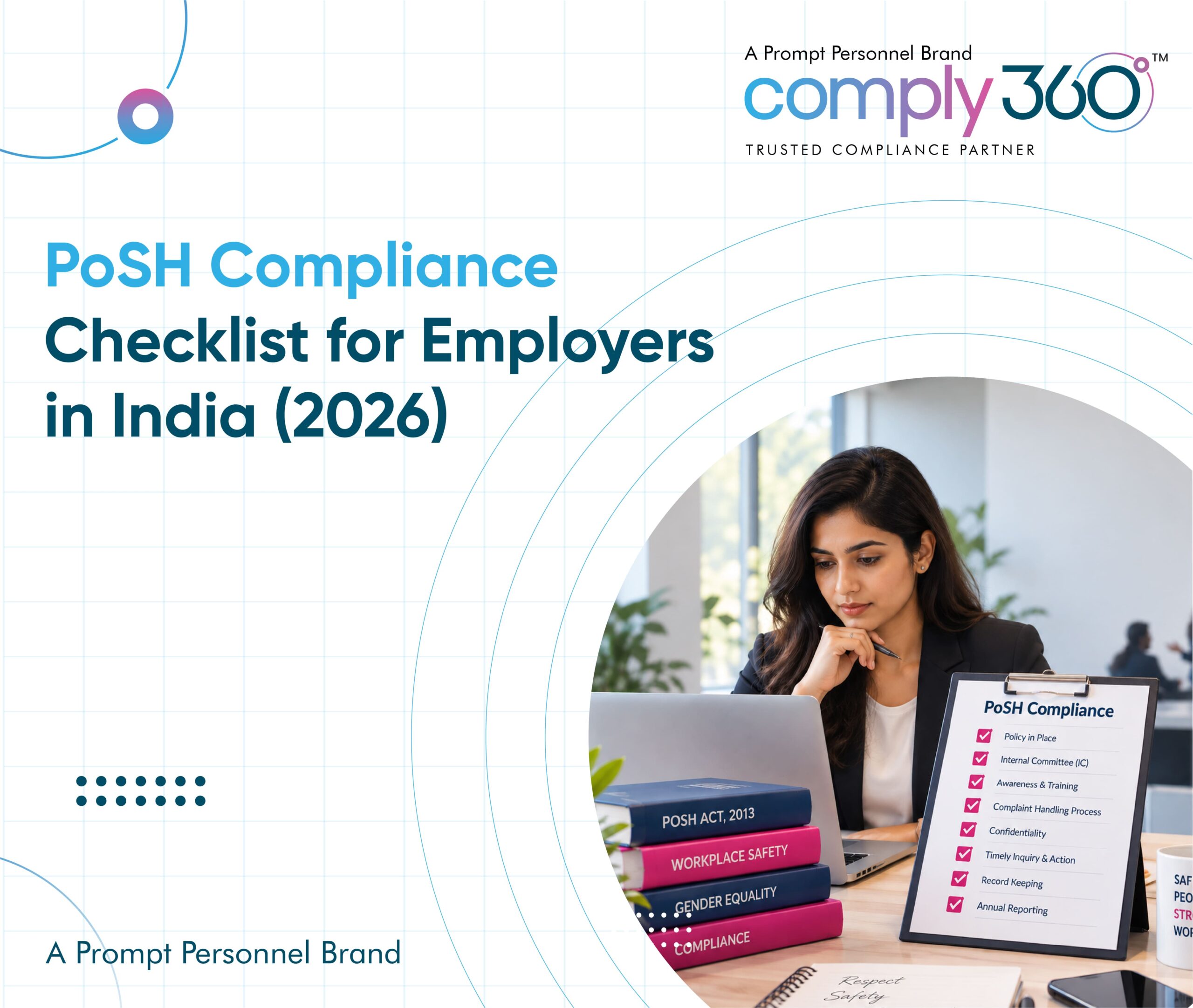
A Practical PoSH Inspection Checklist for Employers
Before an inspection or regulatory notice, employers should review the following:
- Is the PoSH policy updated and accessible to all categories of employees?
- Has the Internal Committee been constituted through a valid written order?
- Are committee members eligible and within their prescribed tenure?
- Has the committee received practical inquiry training?
- Are penal consequences and the committee order displayed prominently?
- Are employee awareness programmes conducted at regular intervals?
- Are complaint and inquiry records maintained confidentially?
- Is there a process for tracking statutory timelines?
- Have annual reports been prepared and submitted?
- Are SHe-Box and workplace details updated where required?
- Can the organisation produce evidence supporting each compliance activity?
Any gaps identified should be assigned to a responsible owner with a clear corrective-action deadline.
How a PoSH Consultant Can Support Audit Readiness
An experienced PoSH consultant can conduct an independent review of the organisation’s policies, committee structure, reporting practices and inquiry procedures.
Effective PoSH services should not be restricted to delivering employee training. They should help the employer evaluate whether its entire compliance framework can withstand regulatory and legal scrutiny.
This may include:
- PoSH policy review
- Internal Committee constitution or reconstitution
- External-member support
- Committee capacity building
- Annual-reporting assistance
- SHe-Box support
Preparing Your Organisation for PoSH Audit
The current direction of PoSH implementation is clear. Regulators are seeking greater visibility into whether organisations have constituted Internal Committees and are implementing the law in practice.
Failure to constitute an Internal Committee, act on committee recommendations or comply with other provisions of the Act can attract a fine of up to ₹50,000. Repeat convictions may result in enhanced punishment and consequences affecting licences, registrations or approvals required for conducting business.
Employers should therefore treat PoSH as a continuous governance responsibility, not an annual training exercise.
A well-conducted PoSH compliance audit can help identify expired committee tenures, missing reports, insufficient documentation and procedural gaps before they result in an inspection observation, employee grievance or legal dispute.
Need to make your organisation PoSH compliant and inspection-ready?
comply360° can support your organisation with PoSH compliance reviews, Internal Committee constitution, external member services, committee training, annual reporting and inspection-readiness audits.
Email: business@comply360.in
Call: +91 90823 34420
FAQs on PoSH compliance:
What is a PoSH compliance audit?
A PoSH compliance audit is a structured review of an organisation’s compliance with the Sexual Harassment of Women at Workplace Act, 2013. It typically examines the PoSH policy, constitution and functioning of the Internal Committee, complaint-handling procedures, training, annual reporting, record maintenance and evidence of implementation.
Why is PoSH compliance audit readiness important in 2026?
PoSH compliance scrutiny has increased, with stronger emphasis on whether organisations can demonstrate actual implementation rather than merely maintain a policy. The Ministry of Women and Child Development has expanded SHe-Box adoption and launched a voluntary PoSH compliance checklist, while workplace and Internal Committee information is receiving increased regulatory attention.
What should employers check during a PoSH compliance audit?
Employers should review their PoSH policy, Internal Committee constitution and tenure, member training, employee awareness programmes, statutory displays, complaint procedures, confidentiality controls, statutory timelines, annual reports, record maintenance and supporting evidence of compliance activities.
How can employers verify whether their Internal Committee is compliant?
Employers should confirm that the Internal Committee has been formally constituted in accordance with the PoSH Act, has an eligible woman Presiding Officer, at least two employee members and an eligible external member, and that at least half of its members are women. They should also verify appointment documentation, member eligibility and tenure.
What PoSH records should employers maintain for an audit?
Employers should maintain the Internal Committee constitution order and appointment records, PoSH policy, training and awareness records, annual reports, proof of required submissions and confidential records relating to complaints and inquiries. Complaint records should be securely maintained with access restricted to authorised persons because the PoSH Act imposes confidentiality requirements.
Are PoSH annual reports mandatory?
Yes. Under Section 21 of the PoSH Act, the Internal Committee must prepare an annual report and submit it to the employer and District Officer. Section 22 also requires the employer to include prescribed information relating to sexual-harassment cases in its organisational annual report or intimate the District Officer where such an organisational report is not prepared.
What is SHe-Box and why should employers check their details?
SHe-Box is the Ministry of Women and Child Development’s digital platform supporting implementation of the PoSH Act. It provides a centralised system for workplace sexual-harassment complaints and maintains information relating to workplaces and Internal and Local Committees. Employers should verify that their workplace and Internal Committee information is accurate and updated on SHe-Box where applicable under relevant government directions or onboarding requirements.