
Blogs
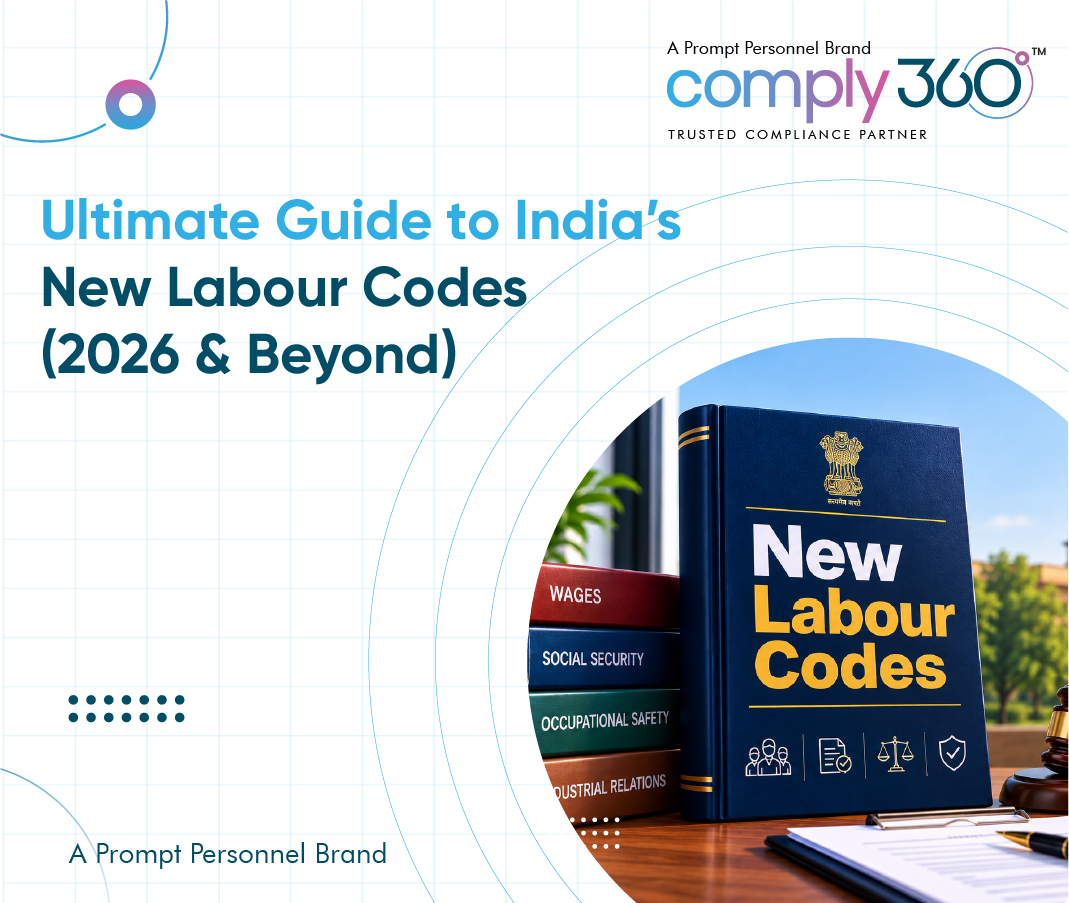
Ultimate Guide to India’s New Labour Codes (2026 & Beyond)
- October 8, 2026
India’s labour law framework has undergone a major restructuring, with four new Labour Codes replacing 29 existing Central labour laws. The four Codes came into force on 21 November 2025, while the Central Rules were notified on 8 May 2026 to operationalise their provisions.
For employers, 2026 is therefore not simply a year of waiting for the new labour codes to begin. It is a year of implementation, payroll review, documentation, registrations, workplace compliance and adapting internal processes to the new framework. Employers must also distinguish between requirements under the Codes, the Central Rules and applicable State Rules based on the relevant jurisdiction.
What Are the New Labour Codes in India?
The new labour codes in India consolidate 29 Central labour laws into four broad Codes covering wages, industrial relations, social security, and occupational safety and working conditions. The government states that the reform aims to simplify the regulatory framework while strengthening worker protections and expanding social-security coverage.
The four labour codes in India are:
- Code on Wages, 2019
- Industrial Relations Code, 2020
- Code on Social Security, 2020
- Occupational Safety, Health and Working Conditions Code, 2020
Together, these Codes establish a consolidated statutory framework for several areas of employment and labour compliance that were previously governed by multiple Central laws.
Why Were the New Labour Codes Introduced?
The new labour laws in India consolidate multiple Central statutes and reduce duplication in definitions, authorities, registrations and compliance processes. The government also highlights wider minimum-wage coverage, expanded social-security provisions, appointment letters, worker safety and technology-enabled compliance as key objectives.
The reform is intended to create a more streamlined regulatory structure while extending statutory protections to a wider range of workers. For employers, this consolidation also requires a review of existing processes that were developed under the earlier labour-law framework.
The Four Labour Codes in India
The four labour codes in India address different parts of the employment relationship.
Code on Wages, 2019
The Code on Wages, 2019 covers minimum wages, payment of wages, bonus and related wage provisions. Minimum-wage coverage is extended beyond the earlier concept of scheduled employment, creating a broader statutory framework for wage protection.
Industrial Relations Code, 2020
The Industrial Relations Code, 2020 deals with trade unions, standing orders, industrial disputes, strikes, retrenchment and other industrial-relations matters. It consolidates provisions that were previously contained in multiple Central labour laws relating to industrial relations.
Code on Social Security, 2020
The Code on Social Security, 2020 brings together provisions relating to EPF, ESI, gratuity, maternity benefits and other social-security measures. It also introduces frameworks relating to gig and platform workers.
Occupational Safety, Health and Working Conditions Code, 2020
The Occupational Safety, Health and Working Conditions Code, 2020 addresses workplace safety, health, working conditions, contract labour and inter-State migrant workers. It also establishes provisions relating to occupational safety and welfare requirements applicable to covered establishments and workers.
Key Changes Under India’s New Labour Codes
Several changes are particularly relevant to businesses in 2026.
Revised Definition of Wages
The revised definition of wages applies across the four Codes from 21 November 2025. Where the specified components excluded from wages exceed 50% of total remuneration, the excess is added back to wages for applicable statutory calculations.
This change can affect the basis used for certain statutory calculations and requires employers to review how salary components are structured and treated for compliance purposes.
Appointment Letters
The Labour Codes provide for appointment letters, strengthening formal employment documentation and ensuring that covered workers receive prescribed employment information.
Employers should review existing appointment-letter formats and employment documentation against the requirements applicable to their establishments and workers.
Wider Minimum-Wage Coverage
The Code on Wages expands the framework for minimum-wage protection beyond the earlier concept of scheduled employment. Employers should therefore review applicable minimum-wage requirements and ensure that wage structures comply with the rates and provisions applicable to their establishments.
Expanded Social-Security Framework
The Code on Social Security consolidates provisions relating to social-security benefits and introduces frameworks for categories such as gig and platform workers.
Employers should review their applicable EPF, ESI, gratuity, maternity and other social-security obligations against the relevant statutory provisions.
Workplace Safety and Migrant-Worker Provisions
The OSH framework strengthens requirements relating to occupational safety, health and working conditions. It also recognises a broader definition of inter-State migrant workers, including certain self-migrated workers covered by the statutory framework.
How the New Labour Codes Affect Employers
The labour codes for employers require organisations to reassess payroll structures, employment documentation, registers, HR policies, benefits, working conditions and statutory processes.
The revised wage definition may affect the basis used for statutory calculations such as PF, gratuity and bonus where the 50% rule applies. The Ministry has also clarified that the revised wage definition applies from 21 November 2025.
Employers should therefore avoid treating the labour codes 2026 transition as a documentation exercise alone. Payroll, HR, finance, legal and operations teams may all need to coordinate to identify and implement the changes relevant to the organisation.
New Labour Codes Compliance Checklist for Employers
A practical labour code compliance review should include:
- Review salary structures against the revised definition of wages.
- Check appointment letters and employment documentation.
- Review minimum-wage compliance.
- Reassess PF, ESI, gratuity and other applicable statutory calculations.
- Review working hours, overtime and leave practices.
- Update registers, records and returns.
- Review workplace health and safety requirements.
- Check contract labour and inter-State migrant-worker requirements where applicable.
- Review internal HR policies and employment contracts.
- Track applicable Central and State Rules.
- Identify which Government is the appropriate Government for the relevant establishment.
The Ministry’s 2026 FAQs clarify, for example, that a worker covered by the OSH framework is entitled to overtime at twice the normal rate where the applicable daily or weekly limits are exceeded. The FAQs refer specifically to situations where a worker exceeds eight hours in a day or 48 hours in a week.
Employers should review overtime practices against the applicable provisions of the OSHWC Code and the Rules relevant to their establishment.
New Labour Codes and Multi-State Compliance
Multi-State businesses need to be particularly careful. The new labour codes in India create a common statutory framework, but implementation can still depend on whether the Central or State Government is the appropriate Government for a particular establishment.
The Ministry has clarified that Central Rules apply where the Central Government is the appropriate Government, while State Rules apply where the State Government is the appropriate Government.
Businesses operating across States should therefore maintain a location-wise compliance matrix rather than assuming that one process automatically applies everywhere. The matrix should identify the relevant establishment, appropriate Government, applicable Rules, registrations, wage requirements and other location-specific compliance obligations.
How Businesses Can Prepare for the Labour Codes in 2026
Businesses should begin with a structured gap assessment. Existing payroll structures, HR policies, employment contracts, registers, records and workplace practices should be compared against the applicable Labour Codes and Rules.
The next step is to identify changes that affect employees directly, particularly:
- Salary structures
- Statutory benefits
- Working hours
- Leave and overtime
- Appointment documentation
- Minimum-wage compliance
- Social-security contributions
- Workplace safety
- Contract labour requirements
- Inter-State migrant-worker requirements
Businesses should then assign responsibility for implementing the identified changes across HR, payroll, finance, legal and operations teams.
Finally, organisations should establish a process for monitoring future notifications, amendments, Central Rules, State Rules and other regulatory developments that may affect their compliance obligations.
Common Challenges in Implementing the New Labour Codes
Common challenges include interpreting the new definitions, restructuring salary components, coordinating Central and State requirements, updating legacy HR systems, and ensuring payroll calculations reflect the revised statutory wage definition.
Another challenge is distinguishing the Labour Code itself from supporting Rules and government FAQs. The Ministry has specifically stated that its FAQs are provided for information and that the relevant Labour Code will prevail if there is any variance between the FAQ and the applicable Code.
Employers should therefore use FAQs and other government guidance as interpretive support while referring to the applicable statutory provisions when determining their legal obligations.
New Labour Codes: What Employers Should Track Beyond 2026
Compliance will not end once internal policies are updated. Employers should continue monitoring:
- Amendments to the Labour Codes
- Central Rules and amendments
- State Rules
- Minimum-wage notifications
- Social-security schemes and notifications
- Government FAQs and clarifications
- Industry-specific requirements
- Requirements affecting specific categories of workers
- Changes to registrations, returns and compliance procedures
The new labour codes 2026 framework should therefore be treated as an ongoing compliance system rather than a one-time implementation project.
For businesses operating across multiple States, periodic jurisdiction-wise reviews are particularly important because the applicable requirements may depend on the appropriate Government and the relevant State Rules.
Conclusion
The new labour codes represent a substantial restructuring of India’s labour-law framework. The four Codes became effective on 21 November 2025, replacing 29 Central labour laws, while the Central Rules were notified on 8 May 2026 to operationalise the framework.
For employers, effective labour codes compliance means going beyond updating policies. Payroll structures, employment contracts, employee records, workplace practices, statutory benefits, registers and location-specific requirements should all be reviewed against the applicable legal framework.
Businesses should also distinguish between the Central and State regulatory frameworks. The applicable requirements depend, among other factors, on the establishment, nature of operations and the appropriate Government. Ongoing monitoring of Central Rules, State Rules, notifications and amendments is therefore essential for maintaining compliance beyond 2026.
FAQs About the New Labour Codes
What are the new Labour Codes in India?
The new labour codes in India are four Codes covering wages, industrial relations, social security, and occupational safety and working conditions. Together, they rationalise 29 Central labour laws.
The four Codes are the Code on Wages, 2019; Industrial Relations Code, 2020; Code on Social Security, 2020; and Occupational Safety, Health and Working Conditions Code, 2020.
When did the new Labour Codes come into effect?
The four labour codes in India came into force on 21 November 2025. The Central Government subsequently notified the Central Rules on 8 May 2026 to operationalise the provisions of the Codes.
What are the four Labour Codes in India?
The four Labour Codes are:
- Code on Wages, 2019
- Industrial Relations Code, 2020
- Code on Social Security, 2020
- Occupational Safety, Health and Working Conditions Code, 2020
Together, they consolidate 29 Central labour laws into four broad legislative frameworks.
How will the new Labour Codes affect employers?
The labour codes for employers can affect payroll structures, statutory benefits, employment documentation, working conditions, workplace safety, social-security obligations and compliance processes.
The exact requirements depend on the applicable Code, the establishment, the workers covered and the relevant appropriate Government. Employers should therefore assess their obligations based on the specific circumstances of their organisation rather than applying a single compliance process to all establishments.
How will the Labour Codes affect salary structures?
The revised definition of wages includes a 50% rule for specified components excluded from wages. Where these excluded components exceed 50% of remuneration, the excess is added back to wages for applicable statutory calculations.
This may affect the calculation base used for statutory benefits and contributions such as PF, gratuity and bonus, depending on the applicable statutory provisions.
Do the Central Rules apply to every employer in India?
No. The applicable Rules depend on which Government is the appropriate Government for the relevant establishment.
The Ministry has clarified that the Central Rules apply where the Central Government is the appropriate Government, while State Rules apply where the State Government is the appropriate Government. Multi-State employers should therefore assess compliance on an establishment and jurisdiction basis.
What should employers do for Labour Codes compliance in 2026?
Employers should conduct a gap assessment covering payroll, salary structures, appointment letters, statutory benefits, minimum wages, working hours, overtime, leave, workplace safety, social security, registers and records.
They should also identify the applicable Central or State framework and establish a process for monitoring future Rules, notifications, amendments and government guidance.